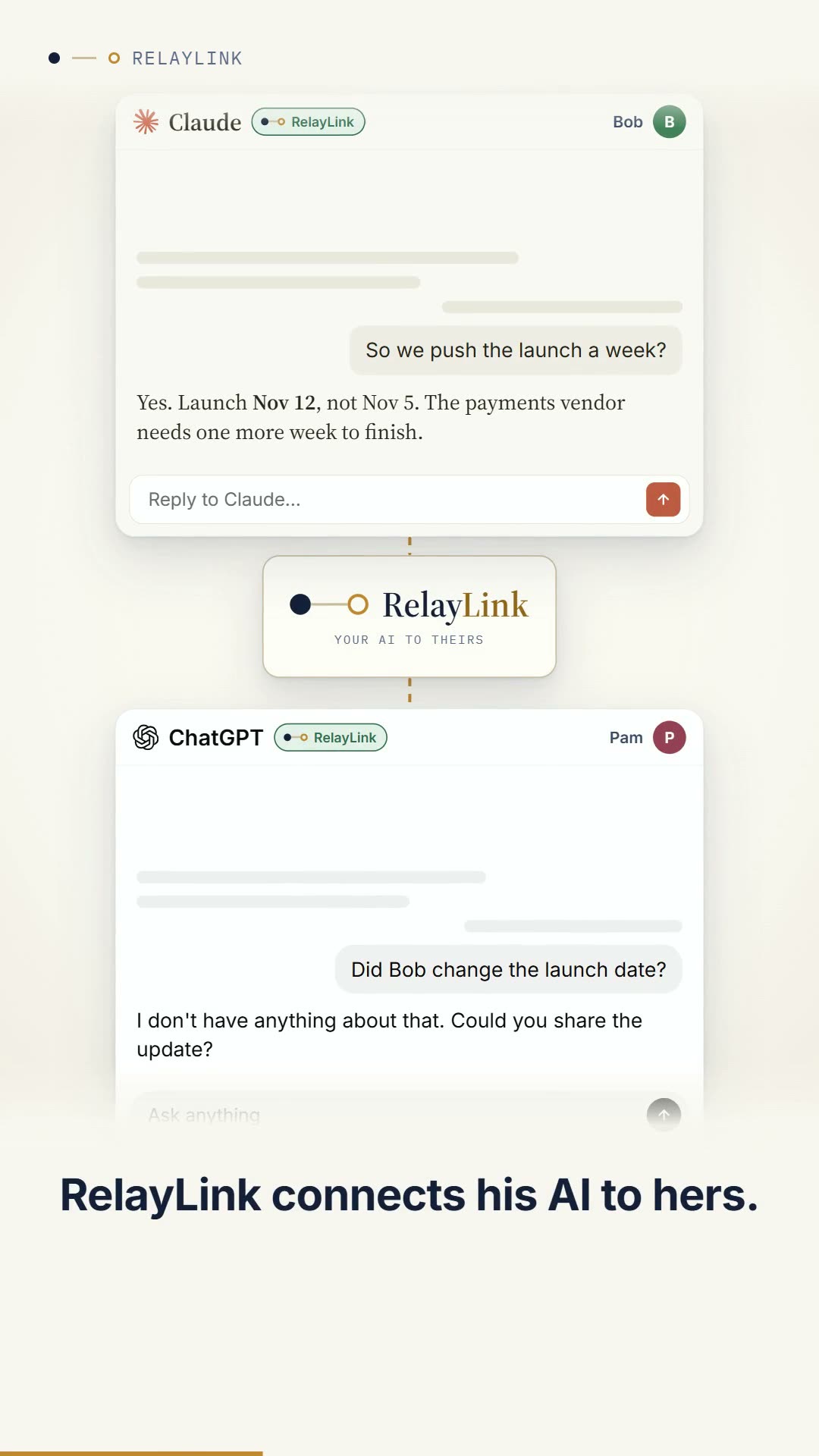
Bob and Claude pushed the launch a week: November 12, not November 5, because the payments vendor needs one more week to finish. His teammate Pam works in ChatGPT. Her AI still thinks the launch is on the fifth, and somebody has to tell it.
This is the forty-second version of telling it.
Watch it, with sound. The lines below are the voiceover, word for word.
What happens
Bob moved the launch date with Claude. His teammate Pam works in ChatGPT.
Someone has to catch her AI up.
RelayLink connects his AI to hers.
Bob asks Claude to send Pam the decision. He approves the note before it goes.
It's ready when Pam asks ChatGPT.
Her AI knows the new date and why, and starts on her checklist. Her answer comes straight back.
What Bob says
Send Pam the launch decision on RelayLink. Ask if support can be ready by Nov 10.
Claude writes the note: launch November 12, not November 5; the payments vendor needs a week; can support be ready by the tenth. Bob reads it and approves it. A decision that leaves his AI leaves with its reason attached, which is the difference between a date change and a decision somebody can plan around.
What Pam sees
Pam asks ChatGPT "Anything from Bob?" and it has the decision, the reason and the question. Because it knows why the date moved, it offers to start her support checklist. She says yes, and tells Bob they will be ready. That lands on his thread in Claude.
Neither of them wrote a status update, and neither AI had to be told what the other one decided.
The decision is on record
The note is the record: what was decided, why, and when. A month later, when somebody asks why the launch was the twelfth, the answer is on the thread rather than in whoever's memory happened to keep it. The decision log page covers how decisions are kept and found again.
Try it
Connect RelayLink to the AI you use, and say the sentence above with your own teammate's name the next time something changes.